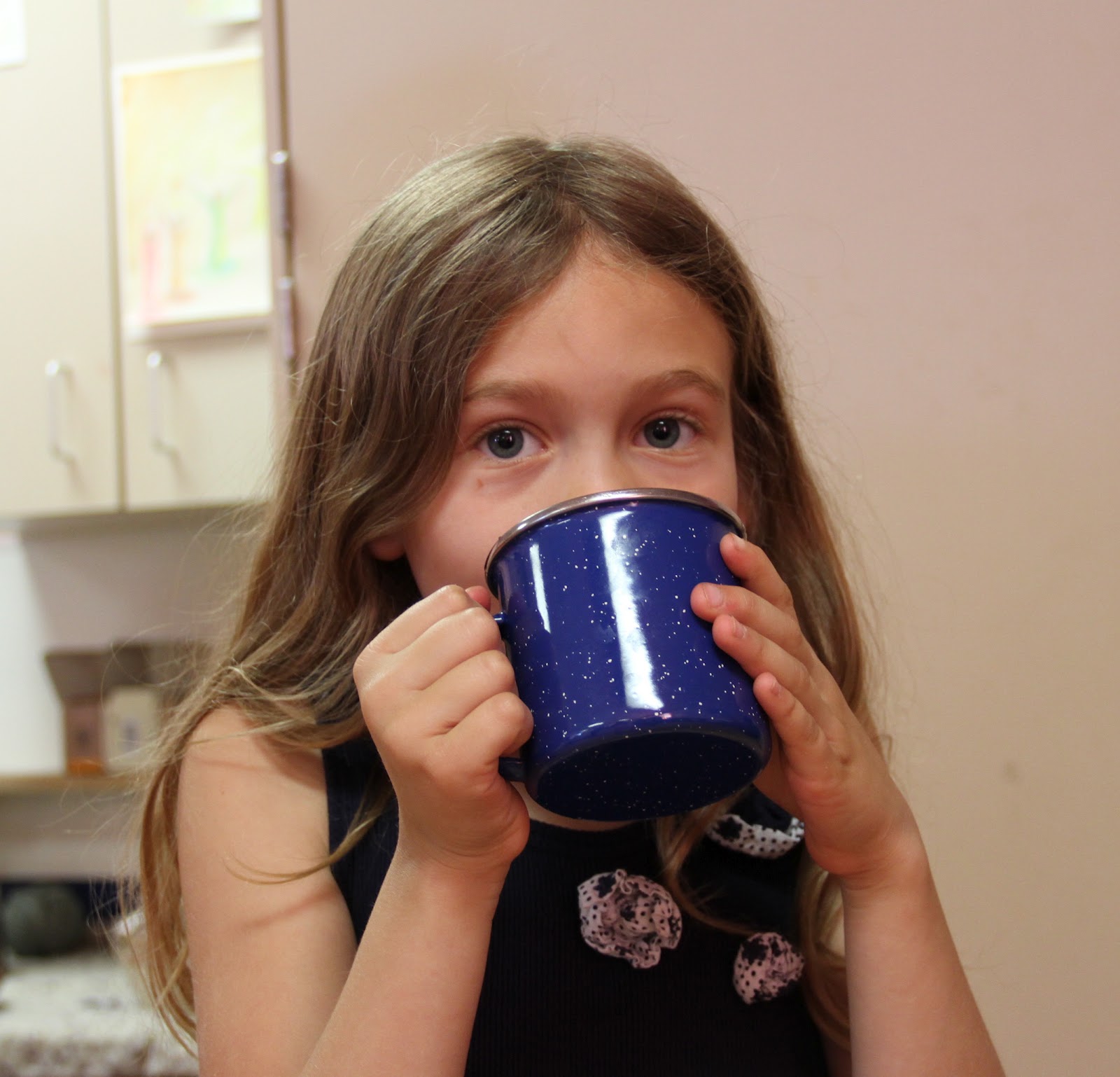
I am particularly grateful for these articles because they remind me, and reinforce for me, that these eyebrow-raising behaviors of my once-predictable daughter are normal and expected. This is comforting when the once-sunny day becomes "the most miserable that has ever been," and the viscous clouds over her once-cheerful head rumble and brood with frightening ferocity. Was is something I said? Is there a way back?
Her 9-year train seems to have left the station right on time, and it's barreling through those mountain passes huffing and puffing -- ethereal steam morphing into sooty black smoke at regular intervals. I've been a perplexed observer most of the time, never sure what to say or do. Do I become more firm? Do I give her the excessive comfort she seems to need while she yells at me for all I'm doing wrong? Do I try to make a joke? Most of the time I end up feeling like I could really really use an instruction manual.
I now realize, after reading one of Emily's articles, that I'm often too intellectual about it. I talk too much. I reason in every which way, or, losing my patience, snap out insensitive comments to "get over it" -- whatever the "It"-du-Jour happens to be. She would if she could.... So, Steiner wrote about Images. And, I did run out and get The Power of Stories -- thank you, Meri :). And I'm feeling like it would help me to take a more imaginative approach to all of this. From one of the articles:
"Rather than seeking an 'intellectual' response to life's questions, what the child really desires is an understanding that arises from the soul -- a 'feeling' understanding emanating from a sympathetic interrelationship with the states of human evolution and the world in general. Thus the most profound question for the child is: 'Who am I and where is my place in the world?' This is a markedly different outlook from the 'dream-like' existence which had been like a protective sheath or cocoon around the child. Instead, the child now begins to search for the 'reality' of life."
From: The Child's Changing Consciousness and the Waldorf Education, by Rudolf Steiner (1923)
I told Avella the other day to go though the mood that suddenly hijacked her happy day with the sobbing threat to remain forever. "You can't go around this or over this -- you have to just go through it." I didn't even know what I meant by it, but now I can see that 9-year train shooting into the side of the mountain through that gaping tunnel that is home to so many ghouls. And, bringing myself into that visualization, I become more sensitive to just how difficult this transition period can be. I remember being frightened by the tunnels at the zoo when the noise of the train suddenly imploded in that thrust into darkness, and familiar faces turned ghoulish in the flashes of sickly light. It seemed everyone around me was laughing and having a grand time. They didn't perceive my distress, or the cause of it. Of course, the cause is imaginary. But it doesn't make the feelings from it any less real. That is what I have to remember with my daughter. I have been there. To our own degrees, we are all still there.
All of this challenges me to remember my own experiences in year 9. It is a difficult place to return to. I don't know why. It seems I can remember my years before and after without much difficulty. But trying to enter into my mind at that age takes some effort. My baby half-brother was just born and our newly-meshed family (from 3 kids to 6) was feeling its growing pains. I was no longer the youngest, but I still received the brunt of my family's bad moods. My 2 natural siblings were both teenagers, and seemed to be flung further and further away from me by some centrifugal force. My mother had moved to her third state and I still didn't see or hear from her very often. My sister was kicked out of the house for her rebelliousness. Our next-door neighbor, my brother's best friend -- the one he played Dungeons & Dragons with and who tolerated his pesky little sister -- was killed in a car accident a few miles from our house just after he got his driver's license. I will never forget that night that we found out. I will never forget the energy that came off of my brother as he ran to his room in the basement. There was no talking about it. I remember sitting alone in my room and drawing a rose in my journal, wondering what I was supposed to feel and think about this thing called death. Shortly after this we moved.... I supposed I'm starting to remember why it is so hard to remember.
I see how my daughter expresses her bold 9 year-old self when her life -- though certainly not perfect -- is a lot more warm, loving, and supportive than mine was. I didn't act out, because it wasn't an option. I'm sure I cried often, but it was done alone. There wasn't anyone in my life at home who wondered -- or had the time to wonder -- what life was like for me. I think I stopped wondering what life was like for myself. By the time I reached 14, I had pretty much stopped talking altogether. I felt I barely existed.
This may sound pretty extreme or depressing, but as I remember all of this, I realize that being fully present and engaged with our children -- particularly as they go through these tremendous transitions -- means helping to bring them to life. It is no less than that. Avella shocked me the other day by saying out of the blue, "Mom! I'm so glad you made me." I laughed but quickly corrected: "I didn't make you, God made you." She said it again, and I corrected again. But I feel now that I stand corrected. God makes all, certainly. But God makes through me. And I make her -- every day. Through my love, guidance, and attention. I know the power of these things, because I experienced not having these things. Like many others.
I wafted ghostlike through my "Feeling" and "Thinking" development years, as the Steiner philosophy perceives them, so that by the time I was in my early twenties, I was almost mad with the question: 'Who am I and where is my place in the world?'. There was no safe place to live through this question as a child. There was no adult who could hold that space or begin to reflect any sort of valuable answer back. At some point, I could not hold that transformative question down any longer -- it burst to the surface like a spitting, seething volcanic eruption. I was 9 years old in my twenties, and it was, I believe, a lot harder to handle.
So thank God my daughter feels safe enough to express her dramas and her fears. Her joys and her sorrows. Her silly songs and dances as well as her rolling around on the floor in devastated agony. Maybe I can stop trying to understand it, and how to respond to it, from a distant intellectual capsule. Maybe I can allow that 9 year-old part of myself to roll around on the floor with her (internally) and wail with an abandon I couldn't express in my childhood. And after we're finished wailing (she outwardly and I inwardly), I might be able to give her an even more compassionate embrace than I could after raising my eyebrows and scratching my head. And maybe it won't take her quite so long as it took me to feel okay about being on Earth in this body and making for herself a perfectly wonderful answer for who she is and where she belongs.
"Our highest endeavor
must be to develop 'free' human beings
who are able of themselves to impart purpose
and direction to their lives."
~ Rudolf Steiner